Loukykvět / Návody / How to grow eucalyptus
How to grow eucalyptus
Published: 10. 5. 2020 · Updated: 10. 5. 2020
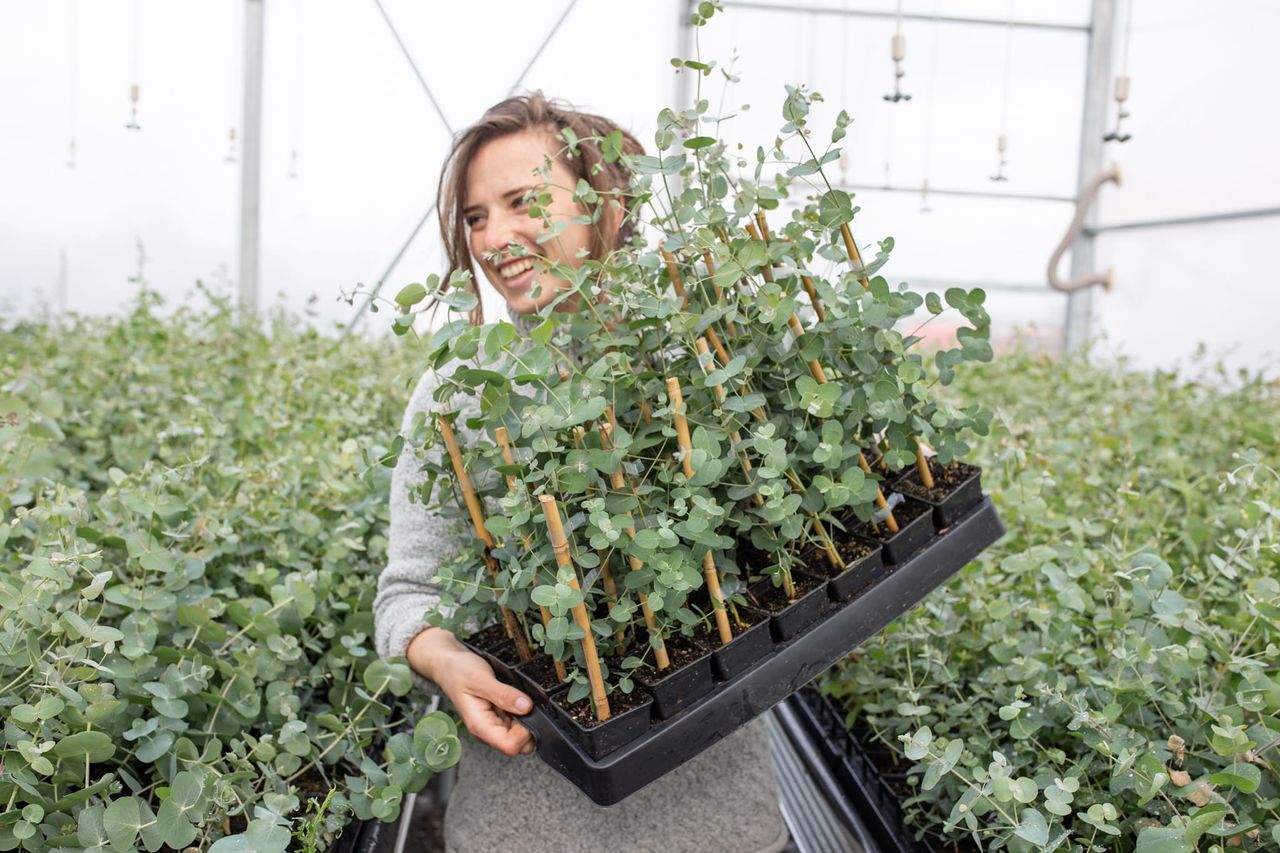
Alongside growing cut flowers, we also dedicate ourselves to growing eucalyptus, as greenery is essential for bouquets. We start our eucalyptus from seeds every year, with part going into our bouquets and the other part reaching you as young plants. To ensure your eucalyptus thrives, we decided to write a short and as honest as possible guide.
Eucalyptus
The most reliable way to grow it is to keep your eucalyptus outside, on a patio or balcony, and as soon as there is a risk of frost, bring it indoors (to a winter garden or a cool hallway).
We don't recommend it much as a houseplant. Only if you have a sunny flat. It definitely won't thrive next to a television where there is barely any daylight, or next to a fireplace or other heat source.
Your eucalyptus will create a lush shrub and spruce up a summer patio, for instance, but don't expect it to replace a walnut tree in the yard. The eucalyptus plants we grow do not have a trained root system and will not become massive trees. If you buy a small eucalyptus from us in May, it will look similar to the large one in August.
Which eucalyptus is this for you?
We would like to set expectations right from the start — eucalyptus is for advanced gardeners. If you are just starting with eucalyptus, stick to this guide; it will go smoothly through the summer, the eucalyptus will grow like crazy, and at the beginning of autumn, everything might suddenly start to fail... Even so, it will bring you joy during the summer, it will smell wonderful, and from time to time you can snip a sprig for a vase or dry it.
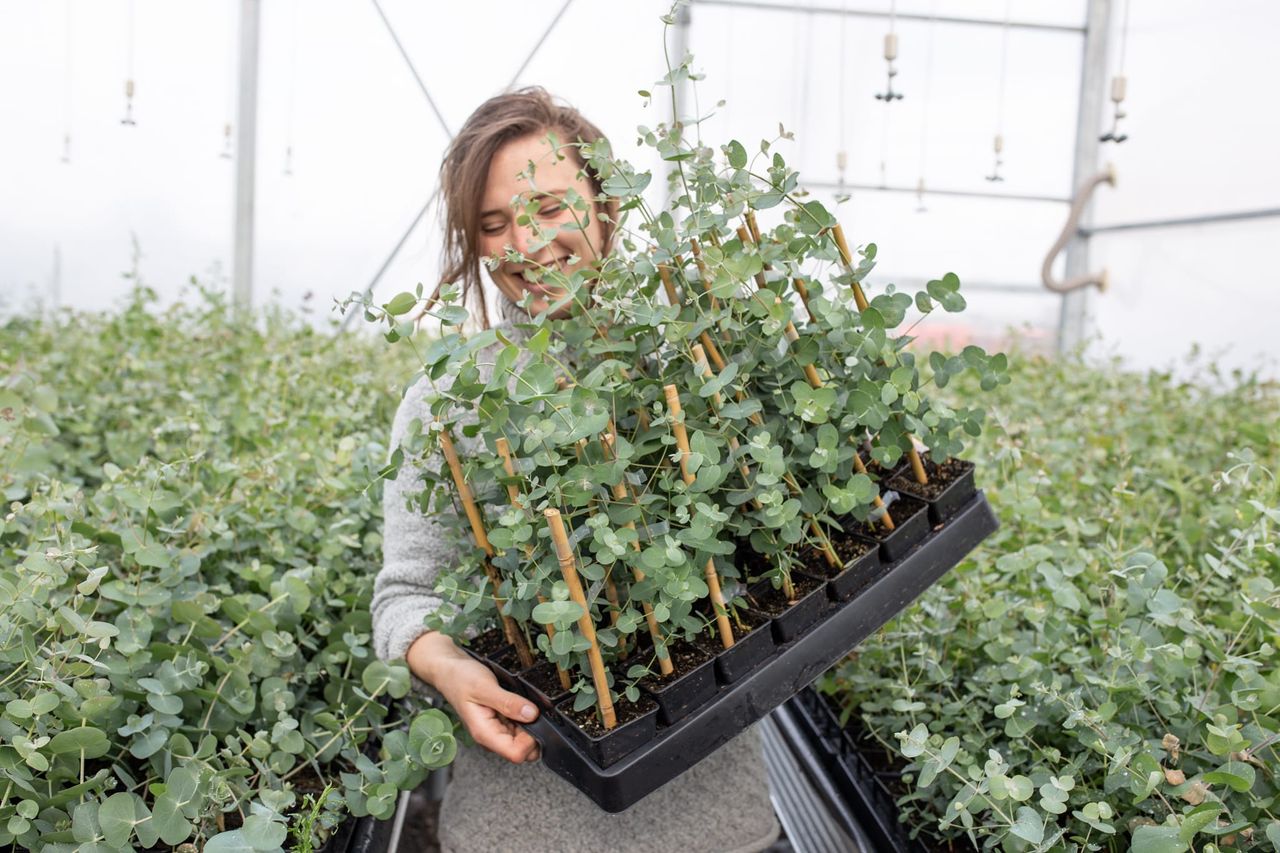
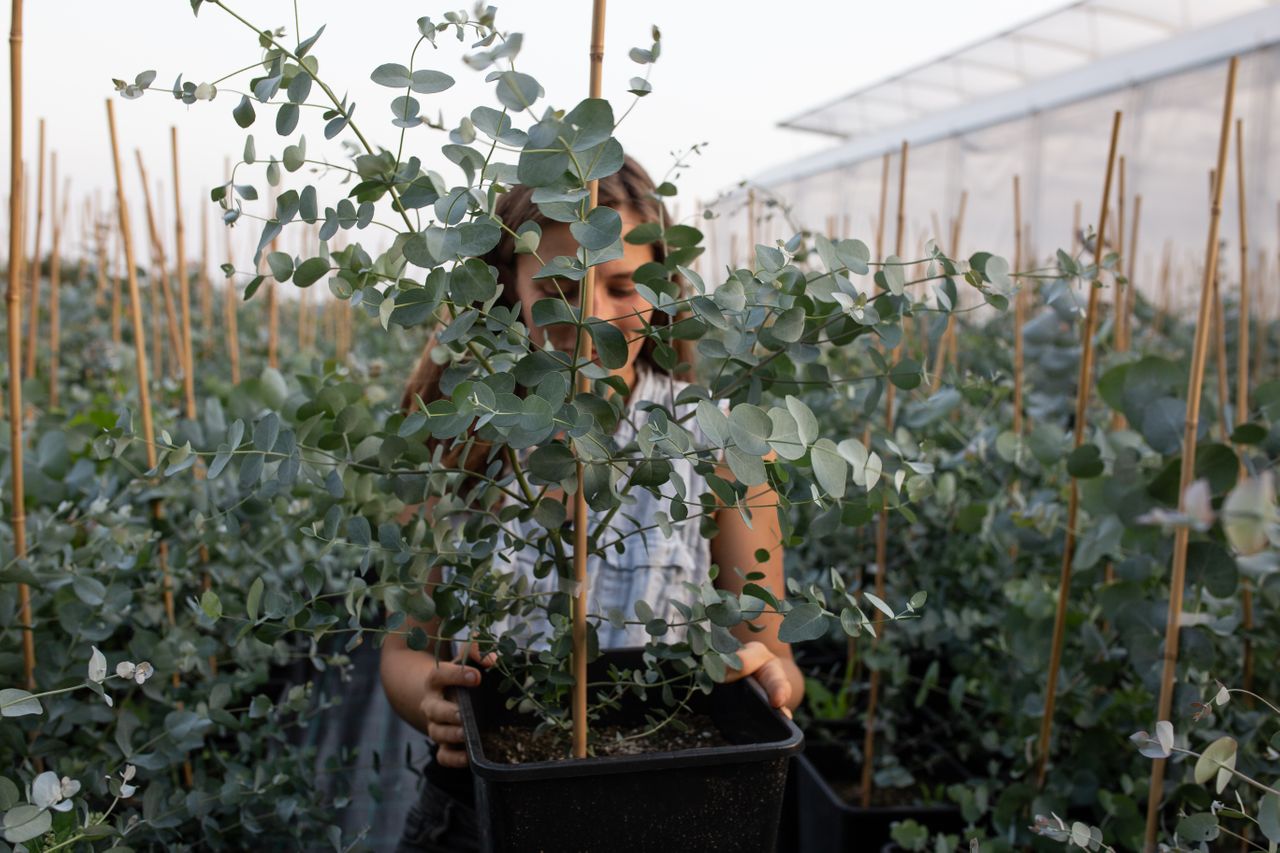
The eucalyptus you can purchase in our shop comes as a young plant. The small one is in a 7×7 (cm) pot, while the large eucalyptus comes in a giant 25×25 (cm) pot. The small eucalyptus is 6+ months old, and the large one is 9+ months, some even 14+ months. On our farm, we grow eucalyptus as small shrubs from which we harvest stems that we then use in arrangements; the shrubs are ~ 1.8 m tall.


Life cycle
From May until September/October, it will grow like crazy. It grows incredibly fast outside during the summer; your eucalyptus will double in size in just a few months. As soon as autumn arrives, with shorter days, less light, and lower temperatures, the eucalyptus will pause.
Be prepared that it will not grow at all during winter, not even a bit. It might survive, but you are more likely to diagnose one problem after another — an edema will appear from high humidity, something will dry up; it is a depressing period, but don't worry, as soon as the days start to get longer and there is more light, the eucalyptus will come back to life, and you will see it sprouting new shoots. At that moment, you have become an advanced gardener, since you managed to overwinter the eucalyptus.
Even though we overwinter eucalyptus on the farm, we prefer to say that it is a tricky task, and you should rather be prepared for a scenario where you fail to overwinter the eucalyptus. It will simply dry out from one day to the next. You won't even have time to notice, nor will you know exactly what happened—whether you didn't water it enough or overwatered it. It will simply turn into a dried biscuit.
Step by step
Location
Sunny, full sun, as much sun as possible. On our farm, we have eucalyptus on a plot of land that gets sun all day long, and we also have a black mulch fabric underneath to intensify it. So, choose the sunniest spot in your garden for the eucalyptus.
Substrate
As a potting substrate, you can use standard gardening peat-based substrate or common soil you have in your garden. Mix the substrate with sand in a 1:4 ratio, i.e., one part sand, four parts soil. Sand ensures the substrate is well-drained so your eucalyptus won't rot.
Pot
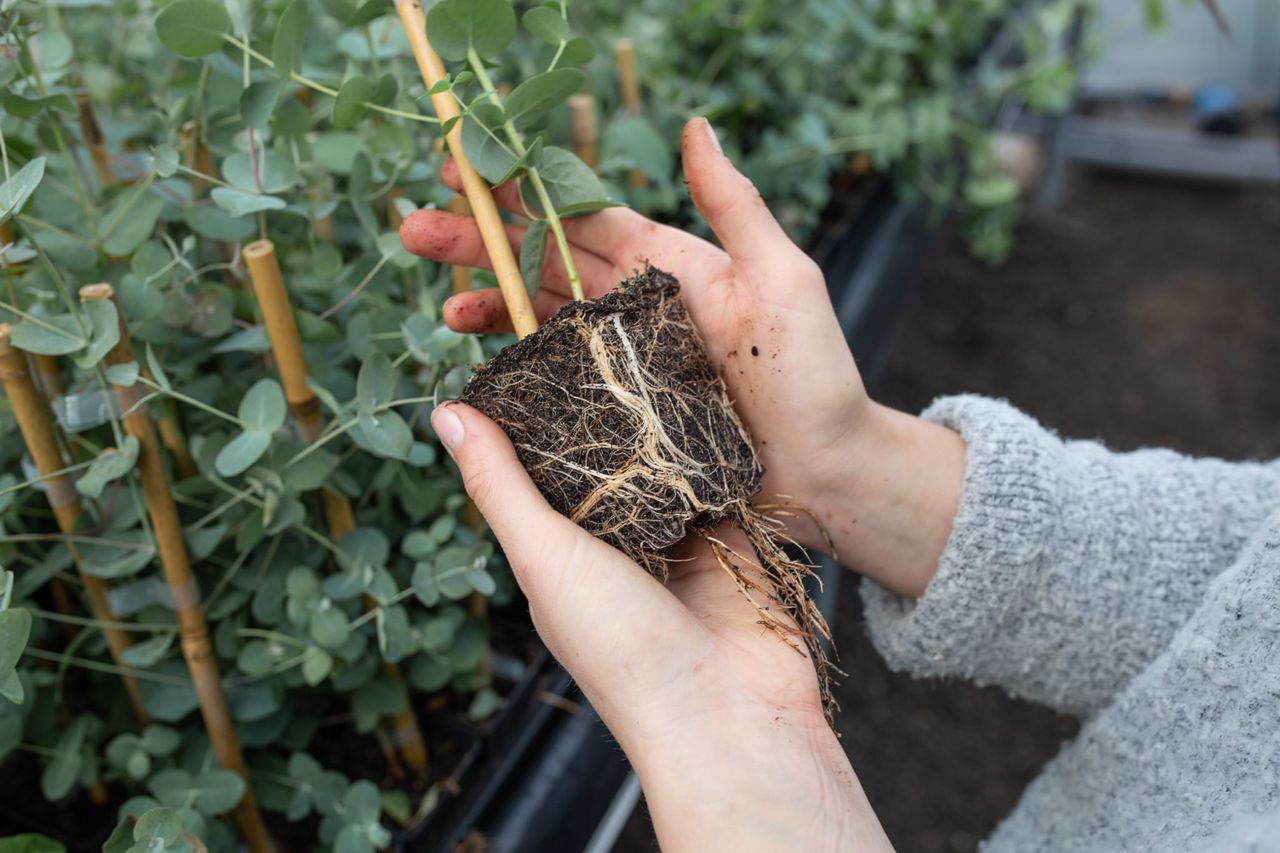
We recommend gradually repotting the eucalyptus into a larger pot. If you order a small eucalyptus from us, it will arrive in a 7×7 (cm) pot. The first thing to do is repot it into a slightly larger one. Do not repot it directly into giant containers.
Go for one size larger, i.e., 9×9 (or 12×12 and similar). If you repot the eucalyptus into a giant pot immediately, there is a risk you could drown it during watering. To give you a better idea — on the farm, we start eucalyptus in seedling trays (ø 3 cm), then we repot it into 7×7 pots, then move it to 12×12, and only then does it make it to the largest 25×25 pot. Every time we skipped a pot size, it caught up with us.
Support
Before your eucalyptus grows strong, we recommend providing support. We use a bamboo stake to which we simply tie the eucalyptus.
Watering
Water the pot only when the substrate has dried out completely. But be careful; eucalyptus will barely survive 4-8 days in dry conditions before it won't recover. You need to balance watering carefully; the eucalyptus cannot stand in water, but it also cannot withstand completely dry substrate.
The best method is bottom watering — place the pot in a saucer. The plant will soak up only what it needs, and you can pour away any excess water from the saucer.
On our farm, we water the eucalyptus once a week during summer via drip irrigation, where water drips directly to the roots for 1-2 hours. In winter, when we overwinter the eucalyptus in our heated greenhouse, we reduce the frequency of watering to about once every 2-4 weeks. Always check that it is not standing in water.
Fertilizing
From April to August, you can fertilize the eucalyptus, ideally once a week.
Do not fertilize eucalyptus with nitrogen; instead, reach for a fertilizer with predominantly potassium (K). Among ecological fertilizers, you can use, for example, ProKton or Free PK. For synthetic fertilizers, choose Kristalon Fruit & Flower (plod a květ) or any other fertilizer where the composition favors K. Kristalon Fruit & Flower has an NPK composition of 15-5-30, meaning there is 2x more potassium (K).
Fertilizer composition
Fertilizers always have their composition and NPK ratio listed, where N is nitrogen, P is phosphorus, and K is potassium. The composition of a fertilizer might be listed as “19-6-20”, which means it contains 19 parts N, 6 parts P, and 20 parts K. If you are looking for a fertilizer with an increased potassium content, the third number (K) should be 2x larger than the remaining two (N and P). The mentioned Kristalon Fruit & Flower has 2x more potassium (K).
Nevíte si rady?
Napište nám na kvet@loukykvet.cz nebo přes Facebook, rádi pomůžeme.


